Say Her Name — Four Years After Mahsa Amini (Part One of Three)
A young woman, a loose headscarf, and the grief that a regime could not bury.
By Andy Alem (آیین) | The New Persian Times | September 17, 2026
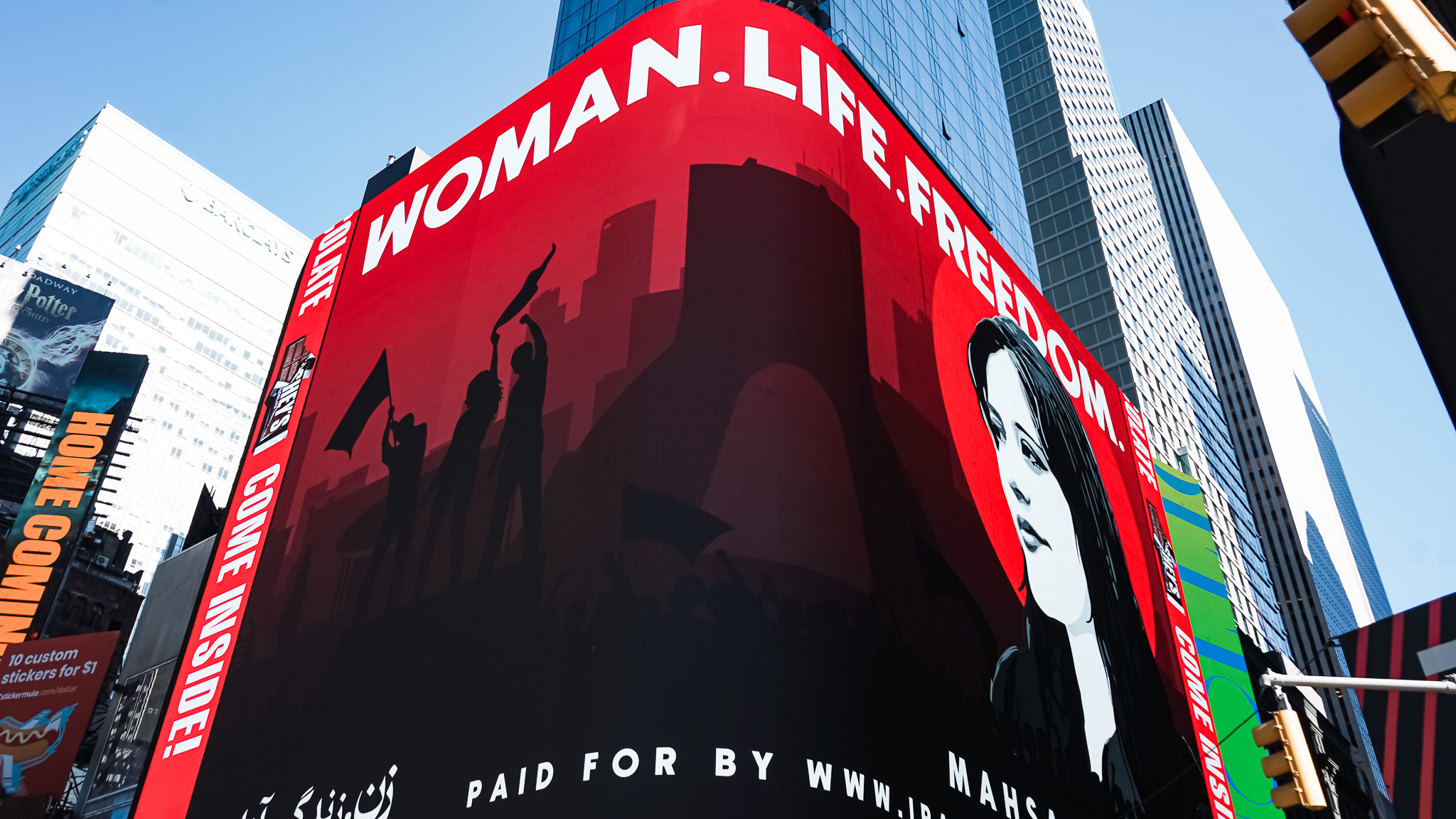
Four years ago this week, a twenty-two-year-old woman from Saqqez stepped off a train in Tehran to visit family. Her name was Mahsa. At home, in Kurdish, they called her Jina — life. On September 13, 2022, the morality police stopped her near a highway entrance because of how her headscarf sat on her head. Within hours she was in a coma at Kasra Hospital. Three days later, on September 16, she was gone.
The regime said her heart gave out. Leaked scans showed a fractured skull and bleeding in the brain. Her family said she was beaten, and eighteen months later a United Nations fact-finding mission agreed: her death was the result of physical violence she suffered in the custody of the morality police.
Iranians did not need the United Nations to tell them. They already knew. Every family in Iran has a daughter, a sister, a mother who has been stopped by those vans. Mahsa was not the first. She was the straw that broke the camel's back — forty-three years of humiliation, landing on one young woman's head.
A grief with nowhere to go
What turned tragedy into outrage was not only how she died. It was everything the Islamic Republic did next.
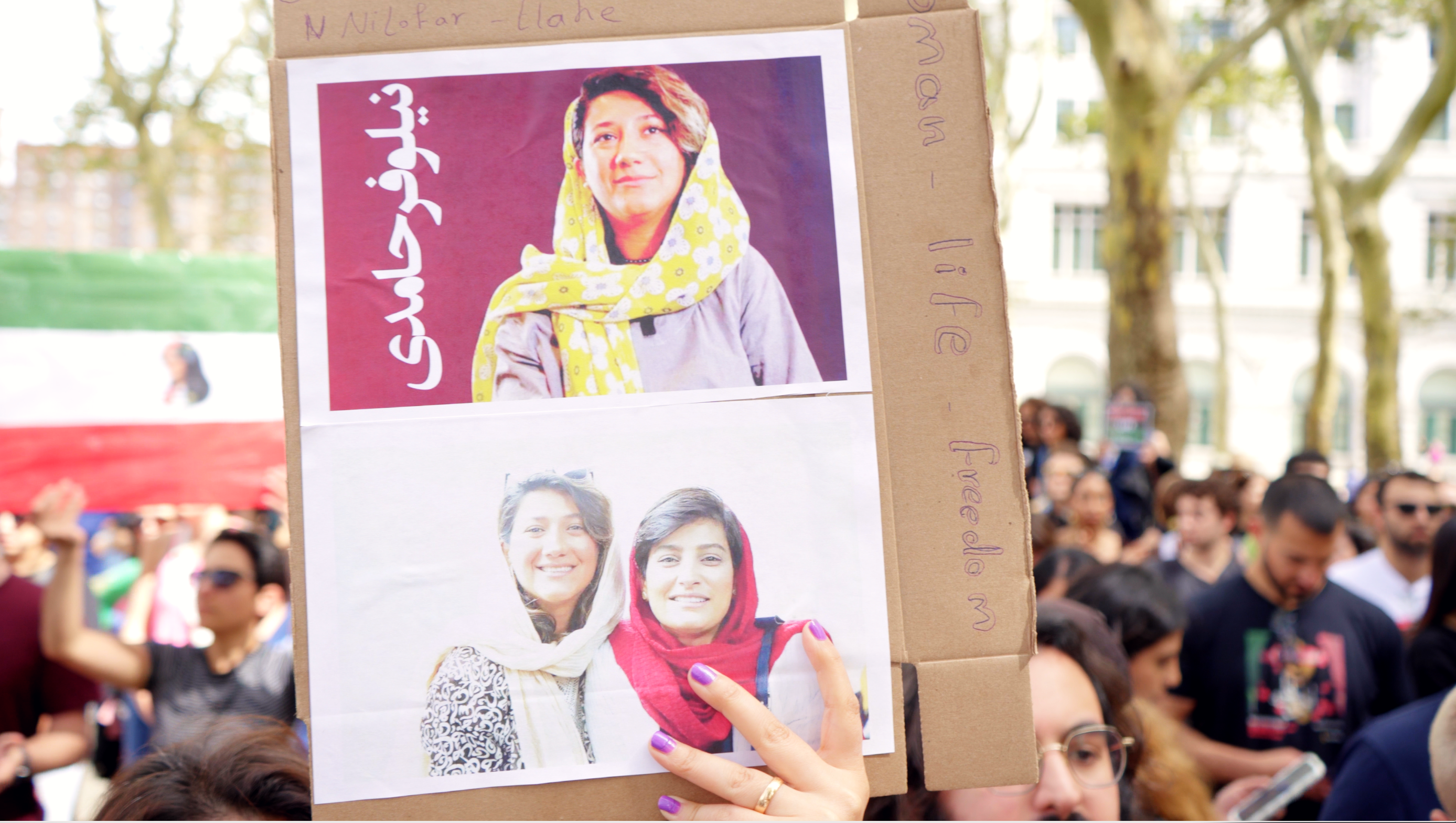
Niloofar Hamedi, a reporter for Shargh, photographed Mahsa's parents holding each other in the hospital corridor and told the world. Elaheh Mohammadi, of Ham-Mihan, traveled to Saqqez and reported from the burial. For doing their jobs, both women were arrested within days, held in Evin Prison — including long stretches in solitary confinement — and charged with collaborating with the United States. They spent roughly sixteen months behind bars and were later sentenced to thirteen and twelve years. The two women who told the truth went to prison. The men who caused it never saw a courtroom.
The family was pressured to bury their daughter quietly, without a ceremony, to "prevent tensions." Thousands came to Saqqez anyway, and the women in that cemetery pulled off their headscarves and waved them in the air. On the fortieth day — the day our culture sets aside to mourn — security forces opened fire on the crowds walking to her grave. On the first anniversary, they detained her father and blocked the roads to the cemetery. A family was denied the most basic human dignity: to grieve their child in peace.
And to this day, there has been no trial. No officer charged. No one held to account for the death of Mahsa Amini.
This is the part the world still doesn't understand about Iranians. Our grief never gets closure. There is no funeral, no verdict, no justice — so the grief has nowhere to go but outward. It spirals. It becomes a street, then a city, then a nation. On her gravestone, her family wrote: "Dear Jina, you will not die. Your name will become a symbol."
They were right.
The names kept growing
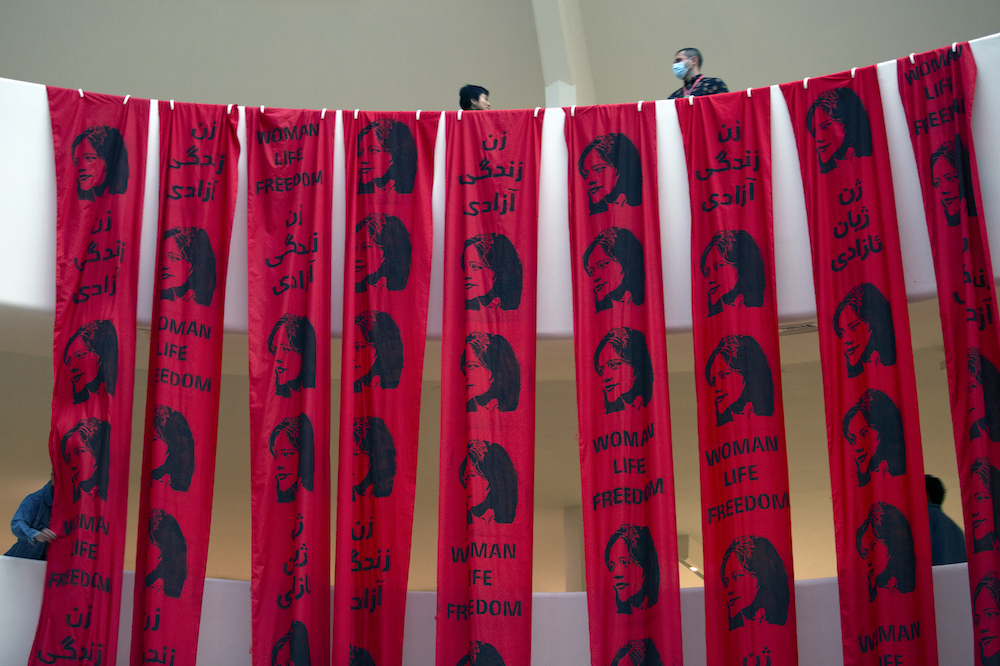
Zan, Zendegi, Azadi. Woman, Life, Freedom. Within days the chant had reached every province in Iran. And then the list began.
Nika Shakarami, sixteen. She went to a protest in Tehran on September 20 with a bottle of water and a towel for the tear gas, and never came home. Her family searched for ten days. When they finally found her, the authorities took her body and buried her in secret, miles from home — on what would have been her seventeenth birthday. A leaked security document reported by the BBC later indicated she died at the hands of the security forces who had seized her.
Sarina Esmailzadeh, sixteen. A bright kid from Karaj who posted video blogs on YouTube about music, school, and food — and about what it felt like to be a girl in Iran. "Nothing feels better than freedom," she said in one of them. On September 23, according to Amnesty International, she was struck repeatedly on the head with batons and bled to death. The regime said she jumped off a roof.
Kian Pirfalak, nine years old. Shot in his family's car in Izeh on November 16. The world came to know him through a video of a little boy testing a boat he had built himself, opening with a line from a schoolbook poem: "In the name of the God of rainbows." At his funeral, his mother stood before the crowd and said: hear it from me how it happened, so they cannot say it was terrorists — because they are lying.
Hadis Najafi. Khodanour Lajaei. Hamidreza Rouhi. The list went on.
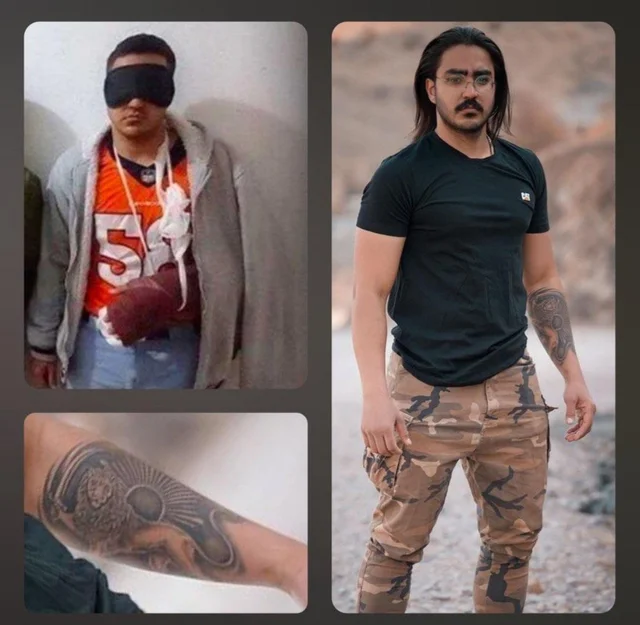
Then came the gallows. Mohsen Shekari, twenty-three, was hanged on December 8, 2022 — the first protester executed, after a trial that was a trial in name only. Four days later it was Majidreza Rahnavard, also twenty-three. They hanged him from a construction crane in a public street in Mashhad, just twenty-three days after his arrest, his hands and feet bound and a black bag over his head. His family was not told until it was over.
Before they killed him, they put him in front of a camera — blindfolded, his broken arm in a cast — and asked for his last wishes. They wanted a broken man. What they got is something no Iranian will ever forget. He said he did not want anyone to pray or recite the Quran over his grave. He did not want anyone to cry. "I'd like them to be happy," he said, "and play happy songs."
Twenty-three years old, facing the rope, and his last thought was for our joy. That is who they were killing. That is who we are.
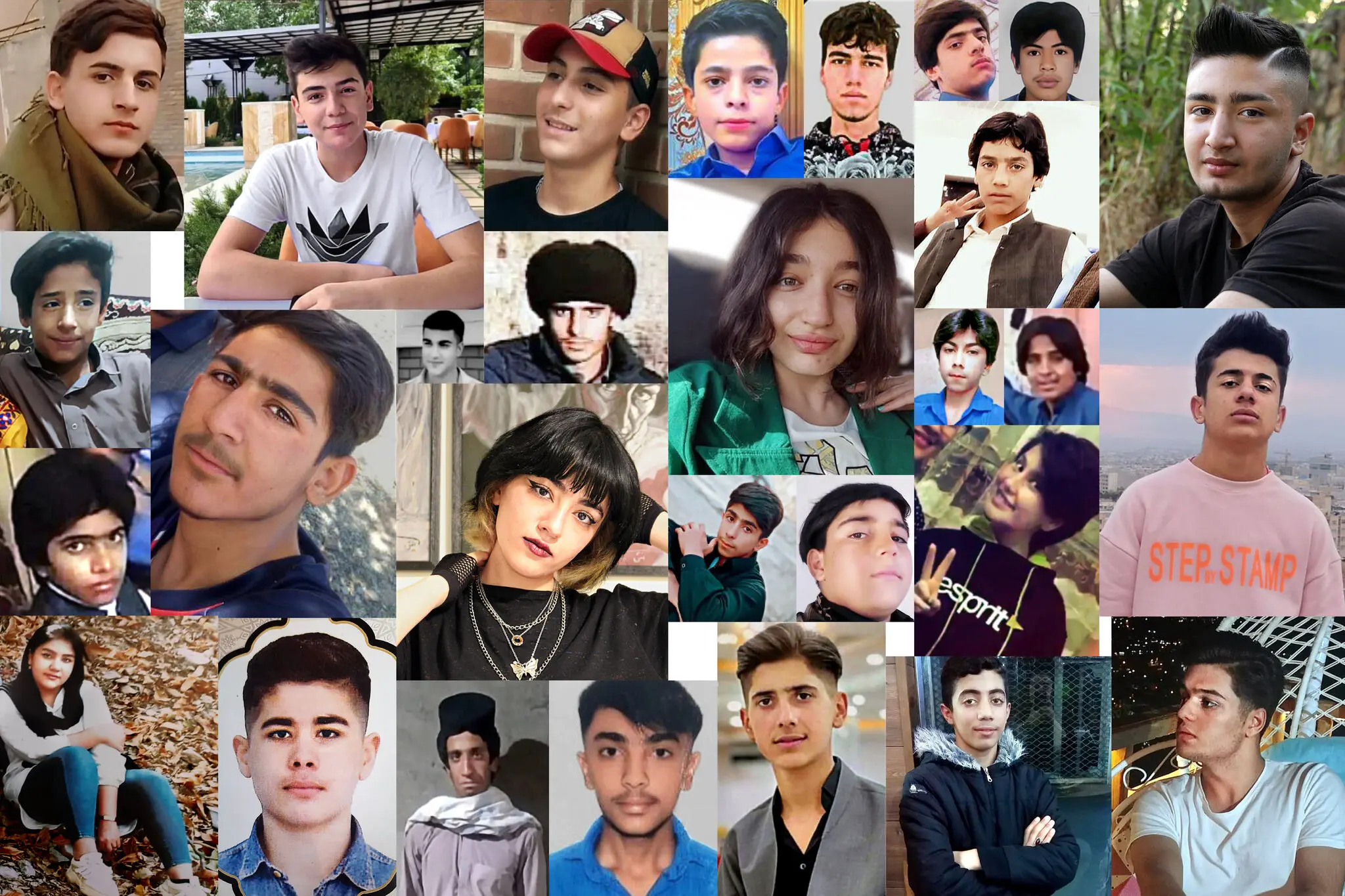
By the time rights groups finished counting, at least 551 people had been killed — 68 of them children — and roughly twenty thousand arrested.
Say their names. All of them. The regime's entire strategy depends on us getting tired of saying them.
One fire after another
It is hard now to convey how fast it all came. Every few days there was a new wound, and each one poured more people into the streets.
Bloody Friday. On September 30, 2022, in Zahedan, security forces opened fire on protesters and on worshippers leaving Friday prayers. Amnesty International documented at least 66 dead; Baloch activists counted close to a hundred, children among them. It was the single deadliest day of the uprising, in one of the poorest corners of Iran — and the Baloch people came back out to protest every Friday for months.
Sharif University. On October 2, security forces laid siege to Iran's most prestigious university, trapping students in a parking garage, firing pellets and tear gas, and dragging them away. These were the country's brightest minds, and the regime treated them like enemy combatants.
The fire at Evin. On the night of October 15, flames rose over Evin Prison — the place where the Islamic Republic keeps its journalists, its activists, its dual nationals, and by then a great many of the arrested protesters. Tehran heard gunfire and explosions into the early morning. Families rushed to the gates, and crowds in the surrounding streets chanted "Death to the dictator." The regime said it was a fight between inmates that started a fire in a sewing workshop, and admitted to eight dead and dozens injured. Witnesses described riot police, tear gas, and a gun battle. Every Iranian family with someone inside those walls spent that night not knowing if they were alive. To this day there has been no independent investigation.
The eyes. And then there was the cruelty that had a signature. Across the country, security forces aimed their shotguns and paintball guns at protesters' faces — at their eyes. Witnesses described the green dot of a laser on a face a moment before the shot. In November 2022, Iranian ophthalmologists warned of more than 580 patients who had been shot in the eye, many of them blinded, and said the real number was far higher. The U.N. fact-finding mission later concluded the effect was intended: to brand a protester for life. Ghazal Ranjkesh, a twenty-one-year-old law student in Bandar Abbas, lost her eye. So did Kosar Eftekhari, a twenty-two-year-old actress in Tehran. A five-year-old girl, Benita, was struck by pellets.
And the wounded could not even go to a hospital. Security agents waited at the entrances. Ambulances delivered injured protesters to detention instead of the emergency room. Doctors who treated them were threatened and arrested. So young people with pellets in their eyes sat at home with ice and hope while the hours that could have saved their sight ran out. Many of them later posted photographs of themselves, one eye gone, smiling. One of them, Mersedeh Shahinkar, would go on to stand in the European Parliament and accept the Sakharov Prize on behalf of the women of Iran.
The athletes. That same week as the Evin fire, climber Elnaz Rekabi competed in Seoul without a headscarf, and came home to a hero's welcome from the crowd waiting at the airport before dawn. In November, at the World Cup in Qatar, Iran's national team stood silent through the anthem of the Islamic Republic while the whole world watched.
The schoolgirls. Beginning that November in Qom, and spreading across the country through the spring, thousands of girls at hundreds of schools were sickened by mysterious gas poisonings. Schoolgirls had been among the boldest faces of the uprising. No one was ever seriously held to account.
Armita Geravand. And on October 1, 2023 — barely a year after Mahsa — a seventeen-year-old girl boarded the Tehran metro without a headscarf and was carried out unconscious. Rights groups say she was confronted and assaulted by hijab enforcers. The regime said she fainted from low blood pressure. Security agents guarded her hospital room; her mother was arrested; so was the journalist who tried to interview her. She died on October 28. The same story, the same lie, the same script. They had learned nothing, because nothing had been done to them.
The only window we had
Understand how we knew any of this. There are no free newspapers in Iran. No foreign camera crews roaming the streets. The two journalists who broke the story were already in Evin. The only tool left to hear the voices of the Iranian people was the phone in a teenager's hand — a shaky clip, uploaded to Instagram, passed from account to account until it reached us on the other side of the world.
The regime knew it, too. Within days it throttled the internet and blocked Instagram and WhatsApp, the last two major platforms Iranians could still reach.
And then the platforms did some of the regime's work for it. The truth coming out of Iran was graphic — because what was being done to people was graphic. Posts were flagged and pulled for violating community guidelines. Protest slogans were removed as "incitement." Accounts that carried the footage were restricted, and those of us amplifying it from the diaspora watched our reach disappear overnight. In January 2023, Meta's own Oversight Board overturned the removal of a post carrying one of the most common protest slogans in Iran, and told the company plainly that it had to do more to protect the speech of Iranians — that in a country with no free press, these platforms are the public square.
Think about that. A people risking their lives to film the evidence, and an algorithm in California deciding it was too upsetting to show.
For the first time, we gathered
And then something happened that has never happened in our history.
For four decades the Iranian diaspora was scattered — by geography, by politics, by old wounds our parents carried out of 1979. We were a people who left, and who mostly kept our heads down. Mahsa changed that. We became the voice of the people inside Iran who were being shot for using theirs.
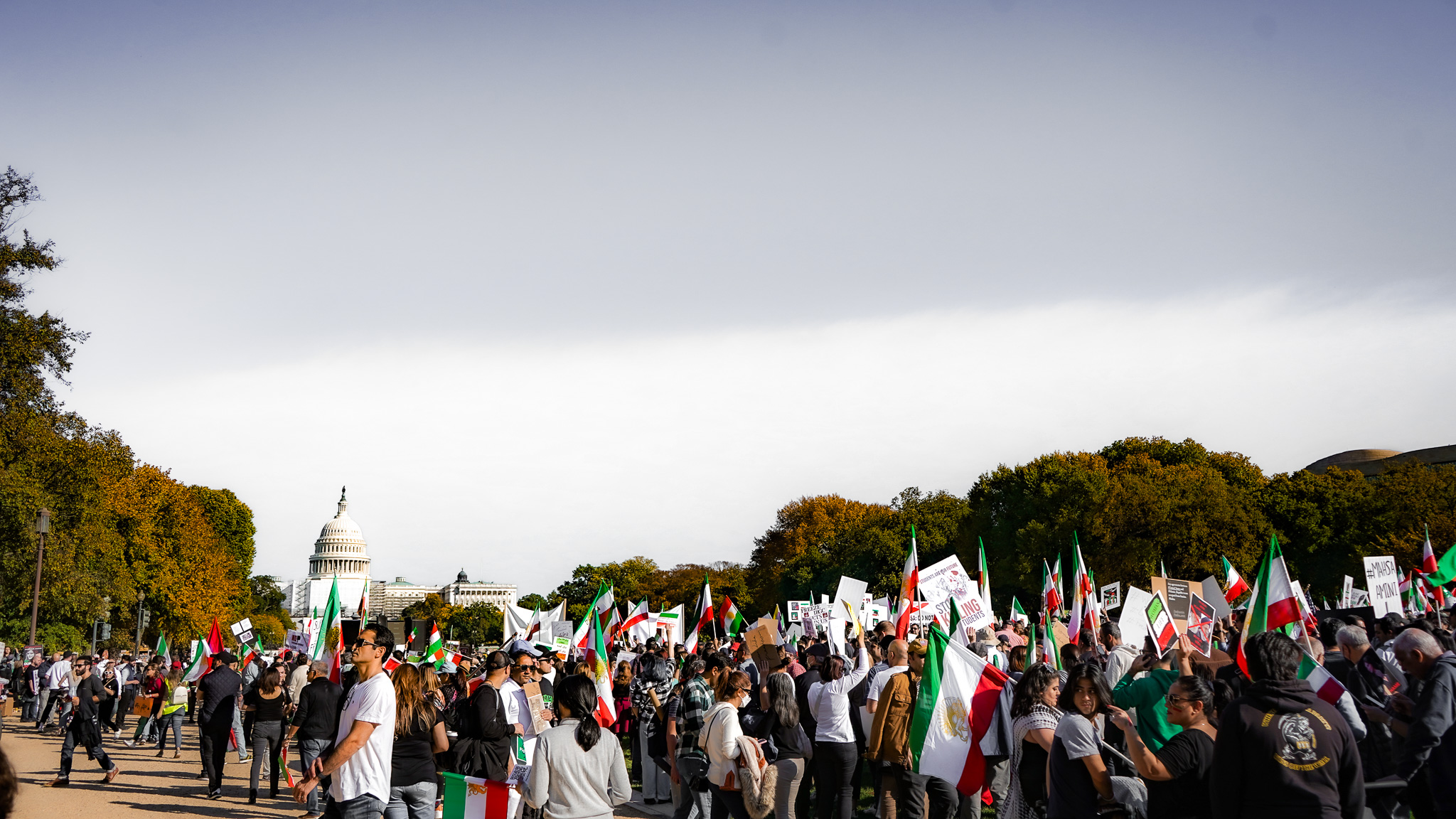
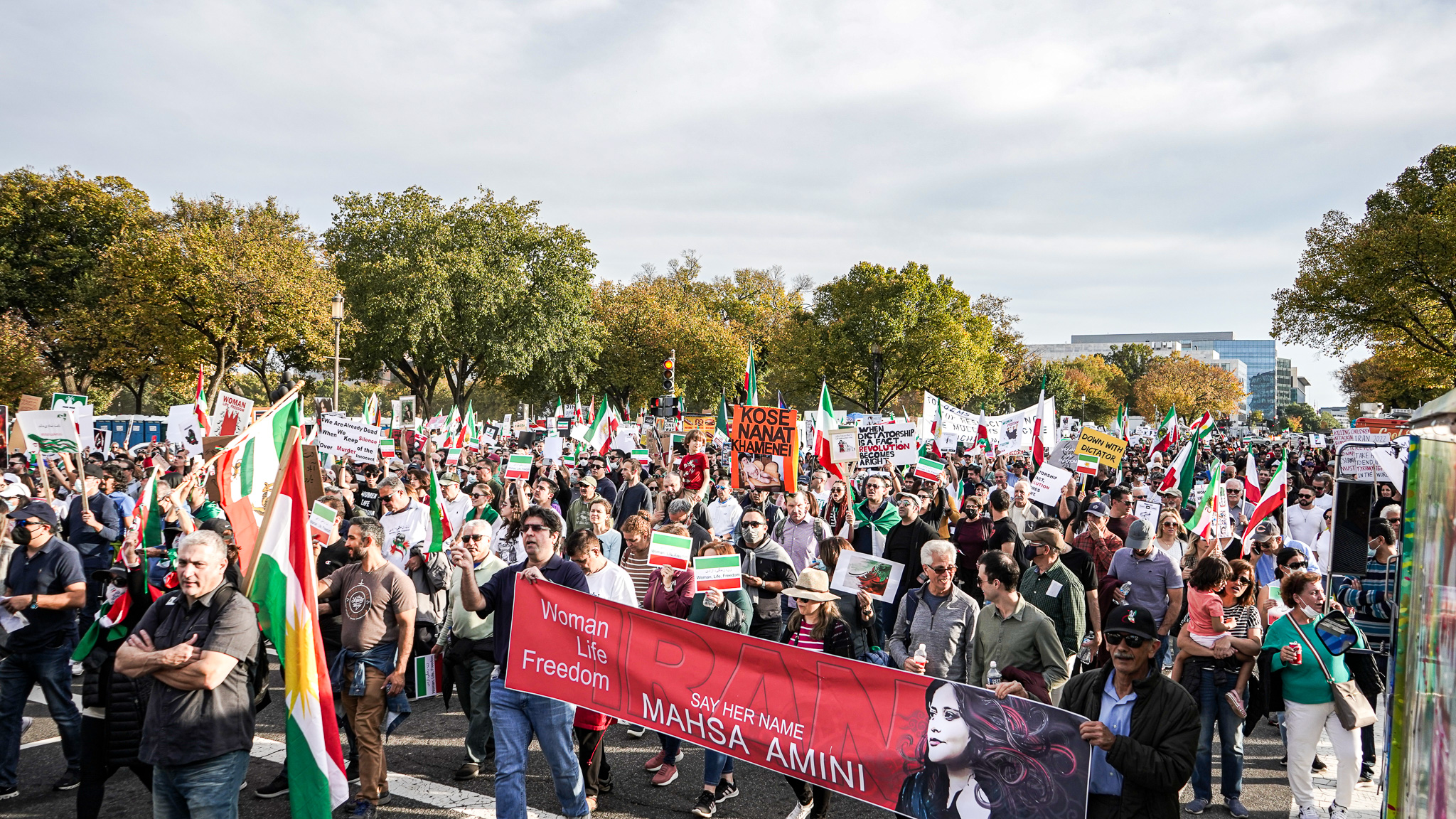
Eighty thousand in Berlin. Fifty thousand in Toronto. A hundred thousand in Los Angeles — the largest Iranian demonstration in American history. Rallies in more than 150 cities around the world. I was there with my camera in New York City and in Washington, D.C., and I can tell you what no headline captured: grandmothers who fled the revolution standing next to college kids who had never seen Iran, singing Baraye with tears running down their faces. Strangers holding each other. A community discovering, in real time, that it was a community.
The New Persian Times captured those days firsthand. I will never forget them.
The song they couldn't silence
That song deserves its own place in this story.
Shervin Hajipour was a twenty-five-year-old singer who sat down in his bedroom and stitched together the tweets of ordinary Iranians, each one beginning with the word baraye — "for." Each line was somebody's reason for being in the street: the small freedoms, the ordinary joys, the sisters and children and futures they were fighting for. The lyrics were written by the people themselves. He posted it to Instagram, and it was heard some forty million times in two days. Then he was arrested, and the song was taken down.
It was too late. Baraye was already the anthem of a revolution.
That fall, the Recording Academy announced a brand-new honor: a Special Merit Award for Best Song for Social Change. The public was invited to submit songs. Of roughly 115,000 submissions, more than 95,000 were for Baraye. That was us — Iranians and our friends around the world, refusing to let one young man's voice be buried. In February 2023, on the Grammy stage, the First Lady of the United States announced Shervin Hajipour as the first winner in the award's history. He watched from Iran, out on bail, banned from leaving the country.
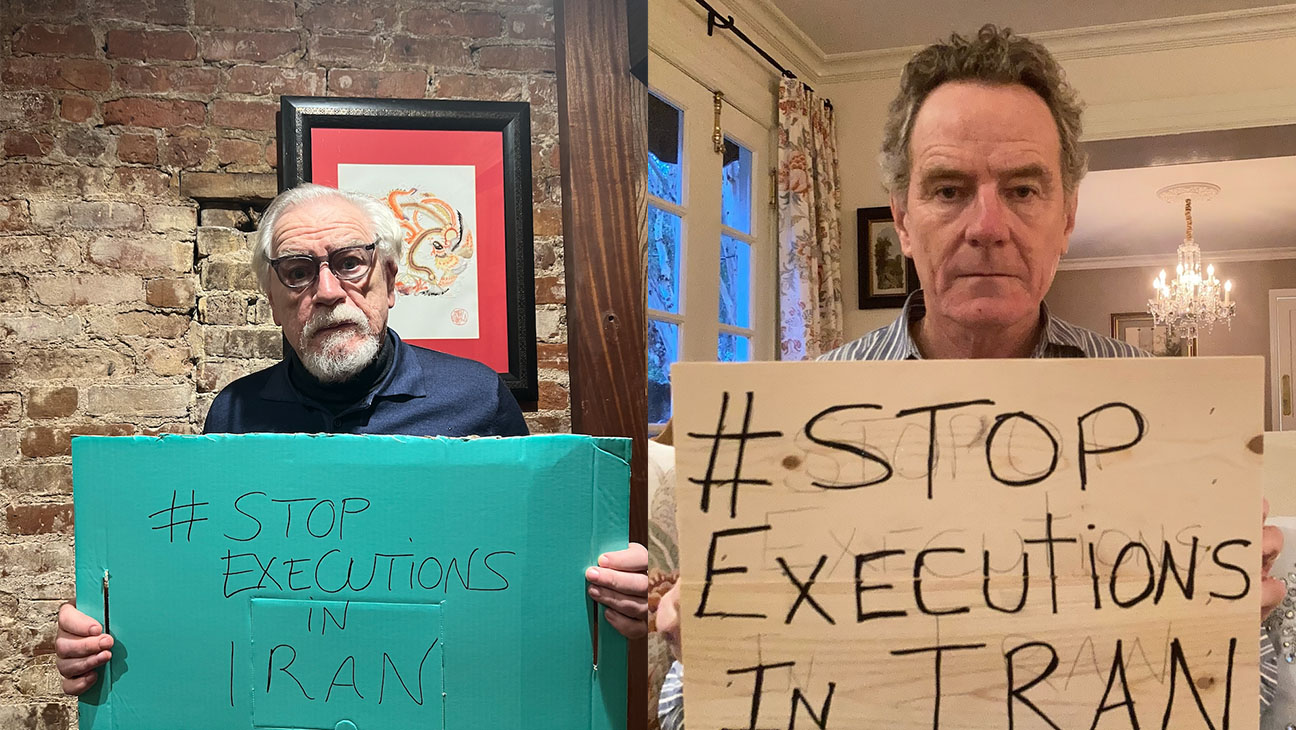
The wider culture followed. Juliette Binoche, Marion Cotillard, and dozens of French actresses cut their hair on camera in solidarity. When the regime began hanging protesters, artists and public figures around the world posted photos of themselves holding a simple handwritten sign: Stop the executions in Iran. And on the red carpets, the statement was worn. At the Cannes Film Festival in May 2023, Iranian model Mahlagha Jaberi walked the steps in a gown whose neckline was a noose, with the words "Stop Executions" across the back.
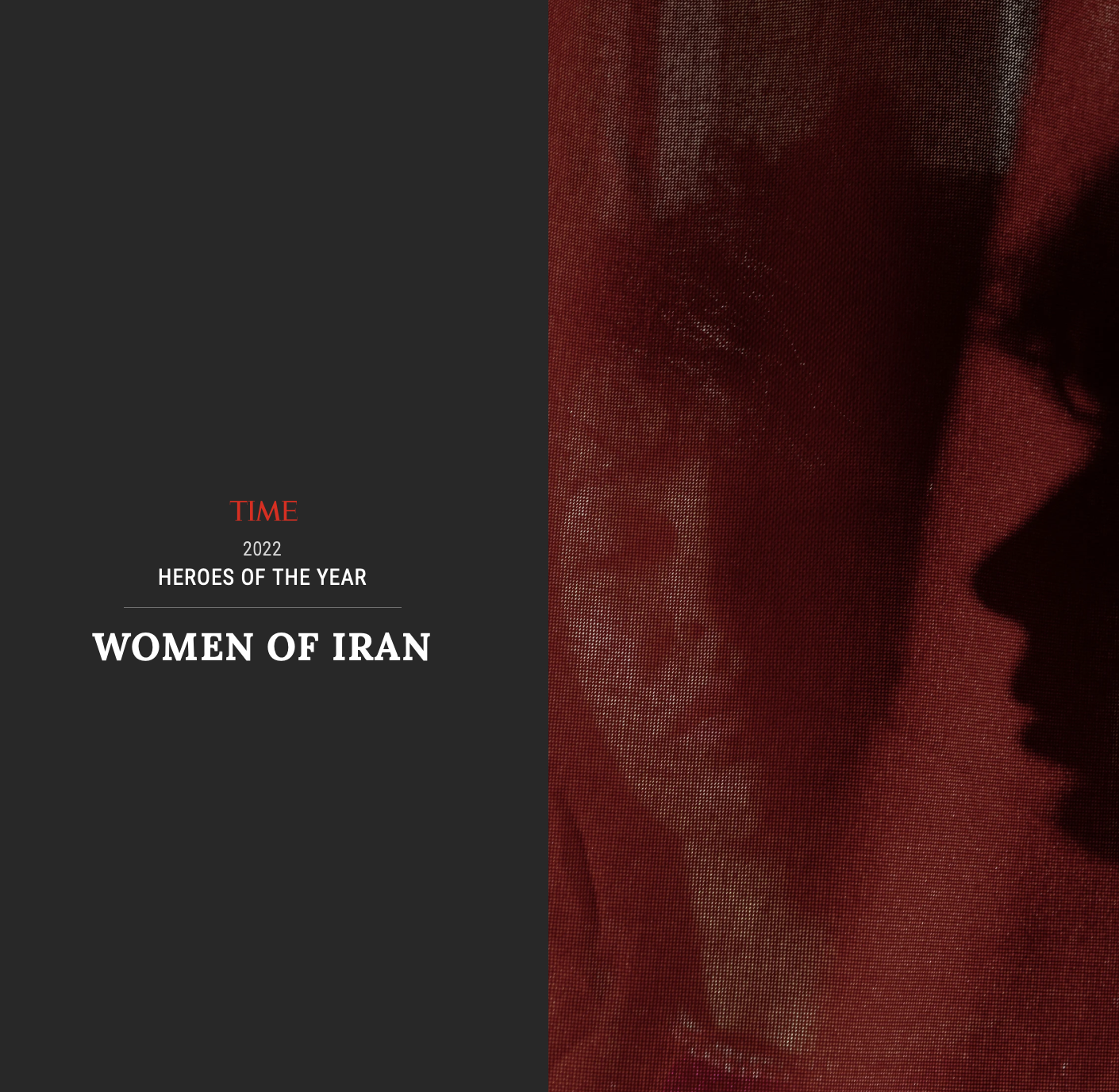
And that December, when TIME magazine closed out 2022, it put them on the cover and named the Women of Iran its Heroes of the Year.
It mattered. Every sign, every song, every dress told the people inside Iran that they were seen. But notice who showed up: the artists, the athletes, the ordinary people.
And notice who didn't.
That is where this story turns — and where Parts Two and Three begin. Because Woman, Life, Freedom did not only show us the courage of the people inside Iran. It showed us everyone else, too: the ones who stood up, the ones who stayed silent, and the ones who had been on the other side all along.
But today is not for them. Today is for her.
To Mahsa, to Nika, to Sarina, to Kian, and to every name on a list that should never have existed: we have not forgotten. We will not get tired. Your name became a symbol, just as your family promised.
May God rest their souls, comfort their mothers and fathers, and let the ones who come after them live in the Iran they died for.
Zan. Zendegi. Azadi.
Always in solidarity. Always for freedom.
Sincerely, آیین
Next — Part Two of Three: "Who Showed Up, and Who Didn't." The silence of the feminist movement, the friendships that ended, the empty chair in New York, the leaders who rose — and a word to the celebrities who chose the wrong side of history. Then, in Part Three: what Washington, Europe, and the United Nations did with our moment, and why I built The New Persian Times.